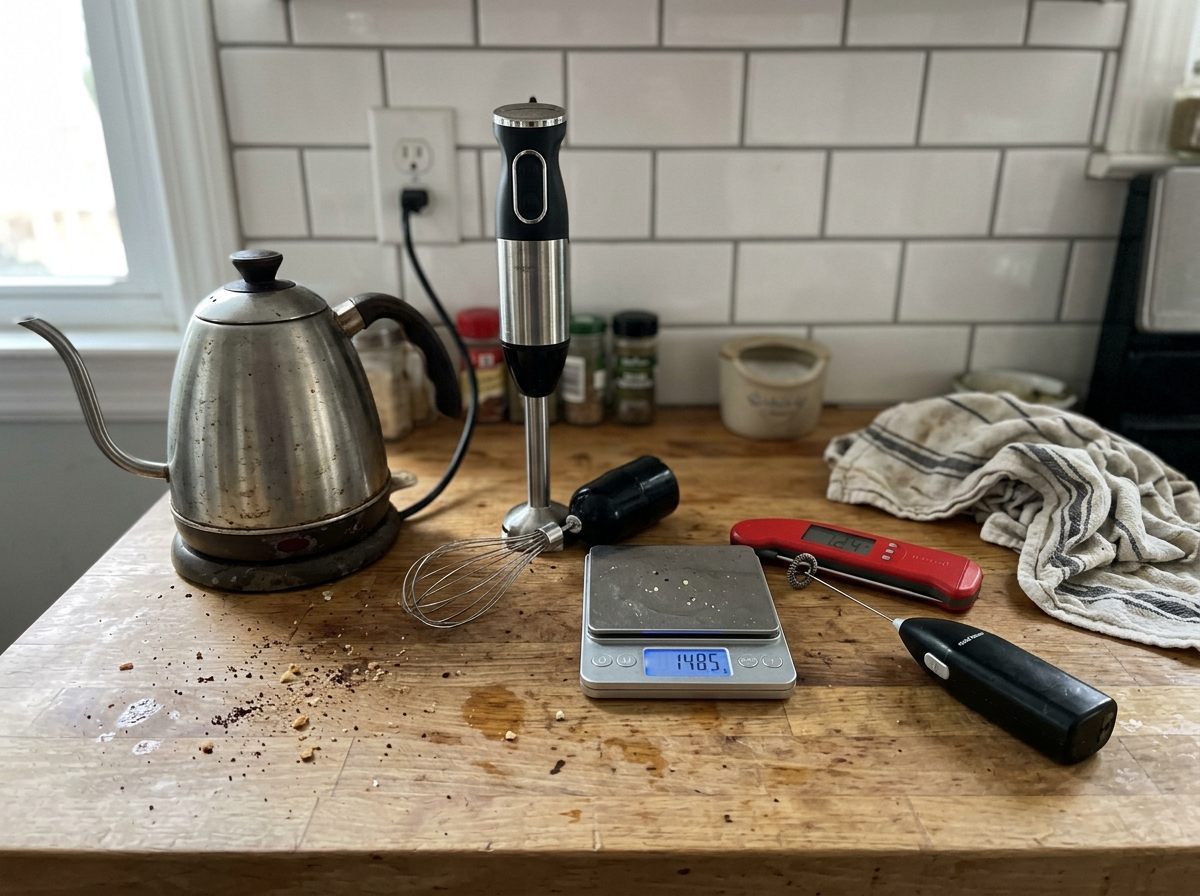
At the start of last year, our test kitchen had a problem: too much stuff. One drawer dedicated entirely to single-use gadgets — a cherry pitter, a corn stripper, something that claimed to core pineapples but mostly just mangled them. Counter space had become a hostage negotiation. We finally did what we'd been avoiding: we pulled everything out, used it all deliberately over twelve months, and decided what earned the right to stay.
The rule we set was simple. If something didn't get reached for at least twice a week on its own merits — not because we were testing it, but because it genuinely made cooking faster or better — it went in the donation box. Out of the roughly 22 items we audited, five made the cut. Here they are.
The five that earned permanent counter space
1. The digital instant-read thermometer
This one replaced our ancient probe thermometer — the kind with a coiled wire and a dial that took 45 seconds to register a temperature and was accurate to within plus-or-minus "probably fine." We now own a digital instant-read model with a folding probe that gives a reading in two to three seconds, and we reach for it constantly. Chicken thighs, pork chops, burgers, even bread. Once you stop cutting into things to check if they're done, you realize how much moisture you were losing every single time.
We also use it for candy and jam making, checking oil temperature for pan-frying, and testing whether our tap water is actually the right temperature before blooming yeast. It's waterproof, the battery has lasted the full year without replacement, and the whole thing fits in a narrow drawer slot when we want it off the counter — though honestly, it mostly lives propped in a ceramic jar next to the stove.
Honest caveat: The magnet on the back is weak. It slides off the fridge if you so much as breathe near it. We keep it in the jar.
2. The gooseneck electric kettle
We were making pour-over coffee with a standard kettle — the kind with the wide spout that dumps water in an ungovernable glug. It worked, technically, but the flow control was a disaster. The gooseneck kettle changed that completely. The narrow, curved spout lets you pour in a slow, steady spiral directly over the coffee bed. Water hits the grounds evenly. The difference in the cup is noticeable within the first week.
Beyond coffee, it turns out a gooseneck kettle is just a better kettle in general. Filling teapots, rehydrating dried mushrooms, making instant ramen without splashing — the precision spout is useful in ways we didn't anticipate. Ours has temperature presets (five of them, ranging from around 160°F to boiling), which means we stopped scalding green tea. The keep-warm function holds temperature for up to an hour, which matters when you're mid-recipe and get distracted.
Honest caveat: It holds about a liter, which means if you're filling a large pasta pot you'll be doing two or three kettles. It's not a workhorse volume kettle. For pasta water, we still use the regular pot-to-tap method.
3. The immersion blender
We had a full-size blender that we hated cleaning. The gasket leaked, the blade assembly was a nightmare to dry, and we genuinely avoided using it unless we had no other option. The immersion blender — a stick blender with a detachable shaft — replaced it for probably 80 percent of our use cases.
Pureed soups directly in the pot. Smoothies in a tall cup. Salad dressings emulsified in thirty seconds in the same container we're serving from. The cleanup is three parts: rinse the shaft under hot water, wipe the motor body, done. We do keep the full-size blender for things that genuinely need it — very large batches, crushing ice — but it now lives in a low cabinet and gets pulled out maybe once a month.
"The first time we made butternut squash soup without having to ladle scalding liquid in batches into a blender, then hold the lid down with a towel while the machine vibrated across the counter — we couldn't believe we'd waited so long."
The model we landed on has a variable speed dial rather than just a high/low toggle, which helps when you want a chunkier texture versus a completely smooth one. The whisk and chopper attachments that came in the bundle have been used exactly twice. No shame in that — the stick itself is the whole product.
Honest caveat: Splatter is real. Blend at low speed first with the head fully submerged, or your ceiling will know what you're cooking.
4. The compact digital kitchen scale
This was the purchase we resisted longest. We'd been measuring flour by volume — scooping, leveling, guessing — for years. The scale was a revelation in the most mundane possible way. Baking became more consistent within the first month. A cup of flour measured by volume can vary by 20 to 30 percent depending on how it's packed; by weight, 120 grams is always 120 grams.
But the scale turned out to be useful far beyond baking. Portioning ground coffee. Dividing dough equally. Scaling a recipe up or down precisely without doing mental math on awkward fractions. We use the tare function constantly — bowl goes on the scale, zero it out, add the next ingredient directly, zero again. Fewer dirty measuring cups, fewer dishes, faster prep.
Our scale sits on a small silicone mat on the counter, which keeps it from sliding and makes it easy to pick up and wipe under. It runs on two AAA batteries; we've replaced them once in twelve months. The platform is large enough for a standard mixing bowl without blocking the display, which is the feature we didn't know we needed until we shopped around a bit.
Honest caveat: Ours maxes out at 11 pounds / 5 kg. That's plenty for most kitchen tasks, but if you're weighing large cuts of meat or doing batch cooking at scale, you'd want something with higher capacity.
5. The handheld milk frother
This is the least obvious pick, and the one that gets the most surprised reactions when people see it on our counter. It's also the cheapest item in this entire lineup — a small battery-powered wand with a spring coil at the tip. We initially bought it as an afterthought and almost didn't include it in the audit.
We use it every single morning. Frothing oat milk directly in a mug for coffee. Dissolving cocoa powder into hot milk without lumps. Whisking salad dressings in a small jar. Mixing instant miso paste into hot water. The frother does in ten seconds what whisking by hand does in ninety, and the cleanup is running it under the tap while it spins.
There's nothing complicated about this one. It runs on two AA batteries that we've changed once. The coil attachment has never bent or lost its shape. It came with a spare coil we haven't needed. For something that costs less than a takeout coffee, it's logged more daily use than anything else on this counter.
Honest caveat: It does not make barista-quality microfoam. If you want the dense, glossy foam that a steam wand produces, this won't get you there. What it makes is light, bubbly, perfectly serviceable froth that transforms a cup of coffee from flat to pleasant. Manage the expectation and you won't be disappointed.
What got donated: the gadgets that didn't survive
Honesty requires a reckoning. Eleven months in, we filled a paper grocery bag for the donation bin. Here's what was in it.
- The electric egg cooker. In theory: perfect soft-boiled eggs, no watching, no fuss. In practice: loud, took up significant counter real estate, produced eggs we could make just as reliably by timing them in a regular pot. The sound it made when it finished could be heard from the second floor. Gone within three months.
- The quesadilla maker. A hinged electric press specifically for making quesadillas. We used it four times. A dry skillet produces a crispier quesadilla in the same amount of time, and doesn't need to be stored anywhere special. This one stumped us — we had genuinely expected to love it. The edges of the quesadilla always overflowed the seal, which meant cleaning cheese off a plastic hinge every time.
- The avocado slicer. A three-in-one tool that claimed to pit, slice, and scoop avocados in one unit. The pitting mechanism worked fine, but a spoon does the scooping better, and a knife handles slicing faster than the plastic fan-cutter ever did. It also only worked well on medium avocados — slightly underripe or overripe and the whole thing fought back. A good knife and a spoon beat it every time.
- The herb stripper. Holes of various diameters that you drag a rosemary or thyme stem through to strip leaves. We used it twice. Pulling the stem through with your fingers takes about the same time, and the tool itself is fiddly to clean when the holes gum up with herb residue.
- The oil mister. We wanted to love this. The idea was right: a refillable pump-mister for olive oil, for coating pans lightly without aerosol cans. But the nozzle clogged within six weeks, and no amount of soaking cleared it fully. It became a frustrating squirt bottle. The aerosol can we'd been trying to replace is still under the counter.
None of these are bad products, exactly. They just lost the usefulness-to-hassle calculation. Either a standard tool did the job better, or the cleanup cost wasn't worth the tiny convenience gain.
What this experiment actually taught us
The pattern in the survivors is consistent: each one either replaced something that was actively annoying to use, or it unlocked a behavior change we couldn't get any other way. The thermometer made us stop guessing. The scale made our baking repeatable. The gooseneck kettle made pour-over actually worth doing. The immersion blender removed the biggest friction point in a pot of soup. The frother made a daily habit slightly better every single day.
The gadgets that didn't survive were all purchased because of a specific, narrow use case — quesadillas, eggs, avocados — and when that use case came up, the gadget turned out to be only marginally better (or actively worse) than the tools already in our hands.
Counter space is finite, and every object on it is making a silent argument for why it deserves to be there. After this year, we've stopped giving that argument to gadgets just because they looked useful in a product listing. The five that stayed have all made that argument, repeatedly, with daily use.
That's the whole test. It's not complicated — but it takes a year to run it properly.