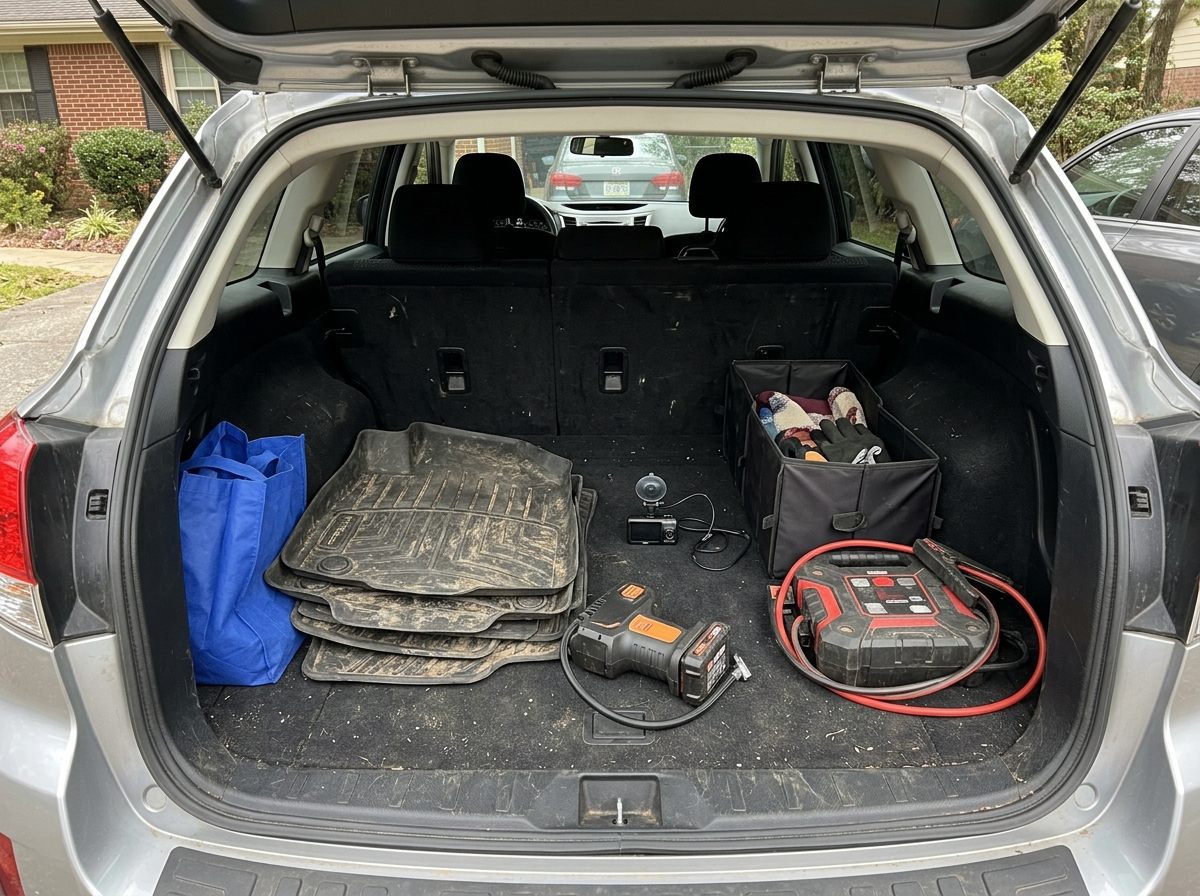
We have spent the last eight months accumulating a genuinely embarrassing pile of car accessories. Some arrived in suspiciously light packages from overseas warehouses. Some came from the end cap of an auto parts store during a long road-trip fuel stop. A few were sent our way by readers who swore by them.
All of them went through the same test: real driving, real weather, real inconvenience. A mix of highway miles, stop-and-go city commuting, a 900-mile summer road trip, and a genuinely miserable January where temperatures barely broke 10°F. By the time we crossed 10,000 miles with most of these things in or on our cars, we had a pretty clear picture of what was worth the money and what was not.
Here is what survived.
The keepers: accessories that earned a permanent spot
A magnetic vent phone mount
We were skeptical. We had used suction-cup mounts for years and accepted their flaws — the slow creep off the windshield in summer heat, the thwack when they finally gave up somewhere near mile marker 94 on the interstate. The magnetic vent mount felt like a lateral move at best.
It was not a lateral move. After one tank of gas we were converts. The mount snaps your phone on and off with one hand without looking down, which turns out to be the entire point of having a phone mount in the first place. Ours has been on the same center vent through a summer that peaked at 105°F and a winter that dipped well below freezing. The magnet has not weakened noticeably. The thin metal disc that adheres to the back of a phone case has not shifted. The vent clip has not loosened.
The one honest caveat: if you use wireless charging, a thick metal disc between your phone and a charging pad will cause problems. We use a separate charging cable and it is a non-issue. If wireless charging in-car is essential to you, look for versions that incorporate a Qi coil into the mount itself — they exist, though they cost more.
A small cordless tire inflator
This one feels almost boring to write about, and that is exactly why it is on the list. You do not think about it for months at a time, and then one Tuesday morning at 6:45 a.m. you walk out to a tire that has lost 12 PSI overnight, and suddenly this $40 gadget sitting in your trunk is the most valuable thing you own.
We have used ours three times in roughly 10,000 miles: once for a slow leak in a rear tire, once to top off a spare on a neighbor's car, and once during the road trip when a drastic change in altitude apparently convinced our tires they needed a pressure adjustment. The cordless design matters more than we expected — not having to park next to an outlet or find the right orientation to reach the valve stem is a genuine quality-of-life improvement over corded versions.
Look for one with a digital pressure gauge that auto-stops at your target PSI. The ones with manual shut-off valves require you to watch the gauge and kill the motor at exactly the right moment, which sounds fine until it is dark and cold and you overshoot by 4 PSI and have to bleed it back down.
A dash cam
We debated including the dash cam because the value proposition is somewhat morbid — you are essentially buying insurance against a scenario you hope never happens. But two members of our team have had accidents in the past two years, and in one case the footage from a dash cam was the only objective record of what actually occurred. The other driver's account and our driver's account contradicted each other in nearly every detail. The footage did not.
"I had been meaning to get one for three years. After the insurance call where the adjuster told me it was going to come down to competing statements, I ordered one that same night. That was a $1,200 lesson that a $90 camera would have solved." — one of our testers, recounting an accident from the year prior
Beyond the accident-documentation use case, we also found the parking mode — where the camera records on motion detection while parked — caught a hit-and-run in a parking garage. The footage was clear enough to read a partial plate number.
Installation matters. A clean hardwire job through the fuse box is far preferable to dangling off your 12V outlet. If you are not comfortable with basic wiring, most quick-lube shops or stereo installers will do it for a small fee. A camera flopping around on a long cable tends to become a camera stored in a glove box.
All-weather floor mats
We tested these through a full winter with heavy snow and road salt, a muddy spring, and a summer road trip that somehow deposited sand from three different states into the footwells. The thick rubber all-weather mats we installed before the first snow have required nothing more than occasional hosing off in a driveway. The original carpet mats, by contrast, had absorbed so much salt and moisture by February that they smelled faintly of something we do not want to describe in a product review.
These are not exciting. There is no clever engineering story. They are shaped pieces of rubber that protect your carpeting. But after 10,000 miles we would not go back to carpet mats for a primary driver vehicle, and we have recommended them to every friend who has complained about ruined flooring.
A compact jump starter and power bank
The jump starter spent most of its life doing nothing in the trunk — and doing it extremely well. It weighs less than two pounds, fits in a small pouch, and doubles as a USB power bank for devices. We used the USB function constantly. We used the jump start function once, on a 17°F morning in January when a battery that had been marginal all fall finally gave up entirely.
The lithium battery inside holds charge for months without being topped off, which was not the case with the older lead-acid booster packs we had used previously. We checked ours after four months of trunk storage and it was still at 80% capacity. That reliability is the whole product.
A trunk organizer
This is the one item on the list that had the most audible skepticism from our team before the test period. "It's a box for your trunk," one of us said. That is, in fairness, an accurate product description.
What changed our minds was the particular chaos of long-distance driving — the reusable grocery bags migrating under the inflator, which slid into the jump starter, which had somehow wedged itself under the spare tire cover. The organizer gave everything a home. The collapsible ones with reinforced bottoms and adjustable dividers were better than the rigid plastic versions, which creak on bumpy roads and eventually crack at the corners.
- Look for one with non-slip base material — the flat-bottomed versions migrate badly on hard acceleration.
- Collapsible sides let it fold flat when you need the full trunk for a big load.
- External pockets for jumper cables or emergency kits keep loose items from rattling against harder objects.
What was not worth it: honest failures
Every review like this wants to be all positive, but the not-worth-it section is where the actual information lives. These are the things we pulled out and either returned or relegated to the trash bag on the back of a headrest.
Cheap seat-gap fillers
The idea is sound — those slots between the seat and the center console are genuine black holes for phones, change, and lip balm. The execution, in the versions we tried, was not. The foam-and-rubber fillers we tested compressed within two weeks into flat strips that no longer filled the gap. The rigid plastic versions fit our specific seats fine but were wrong for a colleague's car and basically non-returnable at that point. The ones with built-in USB ports worked for approximately six weeks before the charging connection became unreliable.
This is a product category where fit and material quality vary enormously, and the low-cost versions we tried could not survive the repeated pressure of someone shifting in the seat all day. We do not have a strong recommendation for a solution here — just an honest report that the cheap ones failed.
A clip-on sun-visor extender
The premise: clip a tinted extension onto your existing visor to cover the gap where sun gets in at low angles. The reality: the clip loosened within three weeks of normal use, the extender flopped down at the most critical possible moments (directly into the driver's line of sight at 70 mph), and the tint level was neither dark enough to help nor light enough to see through clearly. Removed after a near-miss where it dropped unexpectedly.
A flimsy cup-holder expander
Designed to fit in one cup holder and provide two or three smaller slots, the plastic version we tested collapsed under the weight of a standard travel mug the third time we used it. A second version with a rubber base survived longer but vibrated audibly on the highway until we could not stand it anymore. Cup-holder geometry is too vehicle-specific for a universal solution to work reliably in our experience.
Gimmicky LED footwell lights
These looked great in the product photos. In practice, the adhesive backing on the LED strips began peeling away from the carpet edge within the first month. The app-based color control disconnected from Bluetooth regularly. The lights themselves were fine — the implementation was not built for the reality of feet repeatedly moving past the strips, heat cycling, and the general abuse of a car interior. We have seen better-engineered versions at higher price points, but the $15–$20 versions we tested were not worth the installation effort.
A few things we are still evaluating
We have a couple of items that have not quite hit our verdict threshold yet. A wireless CarPlay adapter has been promising but has shown some connection latency that we want to monitor over a few more months. A set of seat-back organizers for the rear seats are holding up but have not been stress-tested with passengers who treat car pockets carelessly. We will revisit both in a follow-up.
Our verdict: what we would buy first
If you are building out a car kit from scratch and want to prioritize by value-per-dollar and real-world usefulness, here is how we would rank the keepers:
- All-weather floor mats. The best boring purchase you can make. Protects real money in resale value. Buy them before the first winter, not after.
- A compact jump starter. Low cost, long shelf life between charges, handles two use cases at once. The one item we actively recommend to family members who ask.
- A magnetic vent phone mount. Genuinely changes daily driving ergonomics. Costs less than a nice lunch.
- A dash cam. The investment case is uncomfortable to make, but the footage is objective and the cost relative to an at-fault determination in an accident is negligible.
- A cordless tire inflator. Situationally critical and otherwise invisible. Exactly what a good emergency tool should be.
- A trunk organizer. Quality of life over a long haul. Lower priority than the first five but genuinely appreciated once you have it.
The through-line in what worked: items that do one thing well, are built from materials that survive heat cycling and vibration, and ask nothing of you until you need them. The failures were almost all products that prioritized the demo — the aesthetic, the app, the clever dual-purpose design — over the durability of the thing that actually has to live in a car for years at a time.
Ten thousand miles is not a definitive lifespan test, but it is long enough to find the cracks. The items above had none.